Pasta Classes In Florence, Bologna And Rome: Prices, Times And Travel
Updated November 3, 2026
Florence has the most bookable pasta classes and the lowest entry price, Bologna has the deepest fresh pasta tradition, and Rome has the widest overall cooking class supply. Here is how the three cities compare on price, duration and the trains that connect them.
 By Andrea Bianchi, Florence pasta-making instructor
Short answer
Florence group pasta classes start at $40 per person, Bologna group classes run EUR 65 to 155, and Rome three-in-one classes start around EUR 52. Trains connect all three: Florence to Bologna takes roughly 35 to 40 minutes, Rome to Florence about 1.5 hours, so a two city class trip is realistic.
Florence, Bologna and Rome are the three cities travellers most often weigh against each other for a pasta making class in Italy, and the honest answer is that they serve different trips. Florence is the volume and value leader: its group classes start at $40 per person and the supply is deep enough to fill slots at 10:00, 13:30 and 17:00 most days. Bologna is the fresh pasta capital, with group classes running EUR 65 to 155 per person. Rome offers the widest total cooking class market, with three-in-one pasta and tiramisu classes from about EUR 52. A reader deciding between them is really deciding what kind of cook they want to be for one afternoon, and this comparison lays out the numbers side by side. If you've already narrowed the field to the two biggest class markets, the direct comparison of Rome and Florence cooking classes shows how they stack up on price, format and how each one fits your itinerary.
Where Should You Take A Pasta Making Class In Italy?
Take the class in Florence if you want the lowest price and the biggest choice of times, in Bologna if fresh egg pasta technique is the point of the trip, and in Rome if your itinerary is already anchored there. Florence group classes run from $40 per person, Bologna from about EUR 65, and Rome three-in-one classes from about EUR 52, so the price gap between cities is rarely more than a dinner.
The pattern in search demand tells part of the story. "Cooking class in Italy" draws about 2,900 US searches a month and "cooking class in Rome" about 2,400, while "cooking class in Tuscany" sits near 1,300 and "best cooking class in Florence" at 390. Rome's big number covers everything from pizza tours to market walks, though. When you narrow to pasta specifically, Florence is where the depth is: multiple operators, multiple daily slots, and a price floor that undercuts both rivals.
Bologna earns its reputation on technique. It is the home of tagliatelle, tortellini and the rolled egg dough those shapes come from, and its classes are built around that tradition rather than around a tourist dinner. A 2026 guide to Bologna cooking classes by the operator Chef on Demand lists group classes between EUR 65 and 155 per person, which is the widest price spread of the three cities. The city also has fewer classes in total, so advanced booking matters more there.
Rome's strength is the bundle. A Rome three-in-one class covering fettuccine, ravioli and tiramisu starts from EUR 52, and because Rome anchors most first trips to Italy, the class is usually a add-on to an existing plan rather than the reason for the trip. For a deeper look at whether a class earns its price at all, the question of are cooking classes worth it in Italy deserves its own read.
Florence, Bologna Or Rome: Price And Duration Compared?
Florence offers group pasta classes from $40 per person lasting 2 to 3.5 hours, Bologna group classes run EUR 65 to 155 for roughly 3 hour sessions, and Rome three-in-one classes start at about EUR 52. Florence's most booked classes cluster tightly between $35 and $58 per person, which is why it wins almost every budget comparison between the three cities.
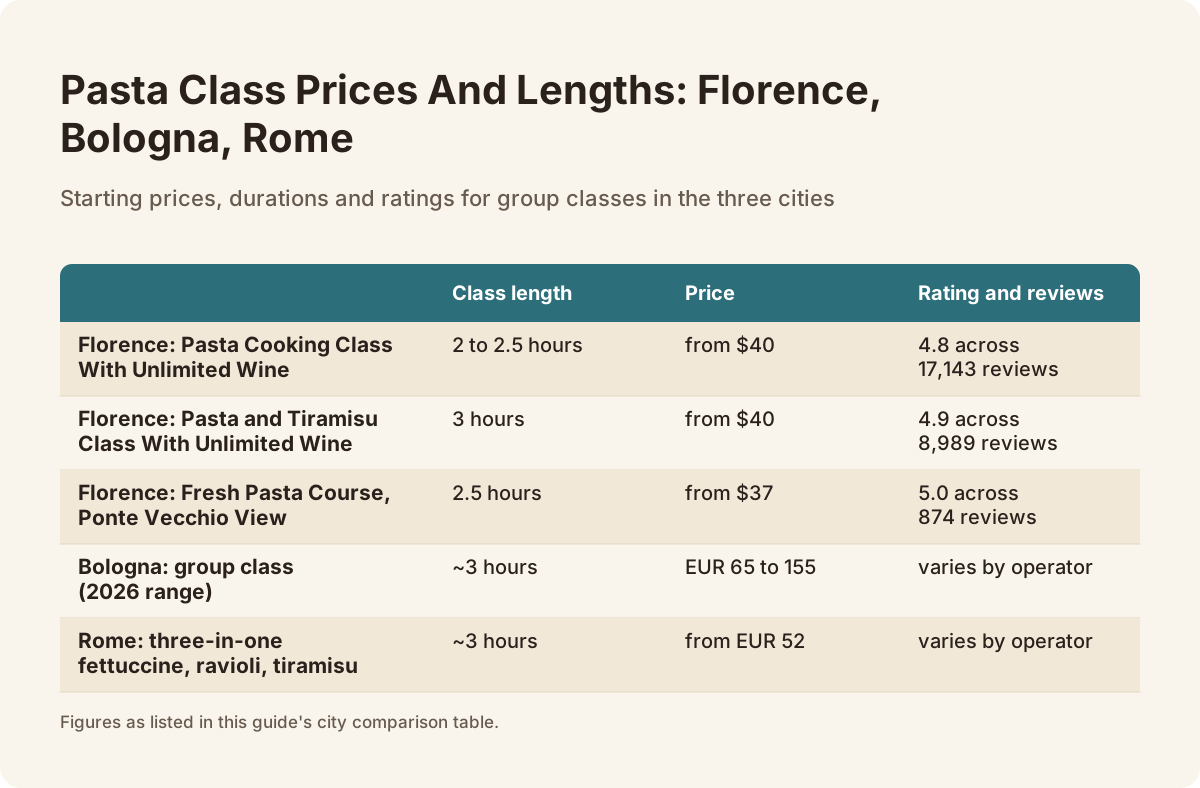
The table below pulls real figures from bookable listings and operator pages in each city. Prices are per person.
| City | Class | Duration | Price | Rating and reviews |
|---|---|---|---|---|
| Florence | Pasta Cooking Class With Unlimited Wine | 2 to 2.5 hours | from $40 | 4.8 across 17,143 reviews |
| Florence | Pasta and Tiramisu Class With Unlimited Wine | 3 hours | from $40 | 4.9 across 8,989 reviews |
| Florence | Fresh Pasta Course With Ponte Vecchio View | 2.5 hours | from $37 | 5.0 across 874 reviews |
| Bologna | Group cooking class (2026 range) | ~3 hours | EUR 65 to 155 | varies by operator |
| Rome | Three-in-one fettuccine, ravioli, tiramisu | ~3 hours | from EUR 52 | varies by operator |
Two things stand out. First, Florence's review pools are enormous: 17,143 reviews on one $40 class is a body of feedback neither Bologna nor Rome can match on a single listing, and it makes the purchase decision much lower risk. Second, Florence's premium end still undercuts Bologna's ceiling: the Michelin trained chef pasta class in Florence costs from $109.50 per person against Bologna's EUR 155 top group rate.
The Michelin trained operator behind one of Florence's premium options publishes its group class from EUR 110 for a 3 hour session capped at 12 guests, per its own site at Pasta Class Florence. That cap is worth noting: Florence's cheap classes can seat large groups, and the step up in price mostly buys you elbow room.
For a fuller map of what else Florence offers beyond pasta, the best cooking classes in Florence compared covers farmhouse, market and premium formats side by side. If budget is the deciding factor, the breakdown of what a cooking class in Italy costs treats it in detail.
How Do Class Formats Differ Between The Three Cities?
Florence classes are short, wine forward group dinners, typically 2 to 2.5 hours with unlimited wine and everyone eating what they roll. Bologna classes lean technical, with more time on dough work and shapes. Rome's signature format is the three-in-one bundle, teaching two pasta shapes plus tiramisu in one roughly 3 hour session, a structure Florence has since copied successfully.
In Florence the format is remarkably consistent across operators: a chef demonstrates, you roll and shape two or three pasta types, and the class ends with the group eating the results with wine. The pasta cooking class with unlimited wine is the archetypal version, 2 to 2.5 hours from $40 with a 4.8 rating across 17,143 reviews. The city's 360 cooking experience operator runs daily slots at 10:00, 13:30 and 17:00 from a kitchen on Borgo Pinti, about a 10 minute walk from the Duomo, with its group pasta class from EUR 75 per person including unlimited wine, per the operator's own page.
Bologna does not really do the unlimited wine dinner format. Its classes treat the pasta itself as the curriculum: tagliatelle rolled by hand, tortellini folded at speed, the ratios of egg to flour argued properly. Travellers who want to come home with a skill rather than a meal tend to be the ones Bologna suits, and the city's food reputation outside the classroom is the strongest of the three.
Rome's three-in-one bundle is the format most first timers picture: fettuccine, ravioli and tiramisu in one sitting, from about EUR 52. Florence's answer to it is the pasta and tiramisu class with unlimited wine, 3 hours from $40, rated 4.9 across 8,989 reviews, which undercuts Rome on price while matching the scope. Between the two, the shorter Rosso Crudo version, 2.5 hours from $35 rated 4.9 across 591 reviews, is the cheapest way to test whether the format suits you before committing an evening. For a deeper cost per hour view, how long a cooking class runs breaks down what each extra 30 minutes actually buys you.
One recurring Reddit thread in r/ItalyTravel asks for a cooking class in Florence that is not pasta and tiramisu, because the traveller felt the format had become the default everywhere. It is a fair complaint about the genre: pasta plus tiramisu is now the standard bundle in Rome, Florence and to a lesser degree Bologna. Anyone wanting to escape it should look at market tour formats in Florence, where the class follows a produce shopping trip.
Can You Combine Two Cities On One Trip?
Yes, comfortably. The high speed train from Florence to Bologna takes roughly 35 to 40 minutes, and Rome to Florence about 1.5 hours, so a single trip can include a class in two cities without adding a travel day. A morning class in Florence and an evening arrival in Bologna, or the reverse, is a realistic same day plan if you book classes near the stations.
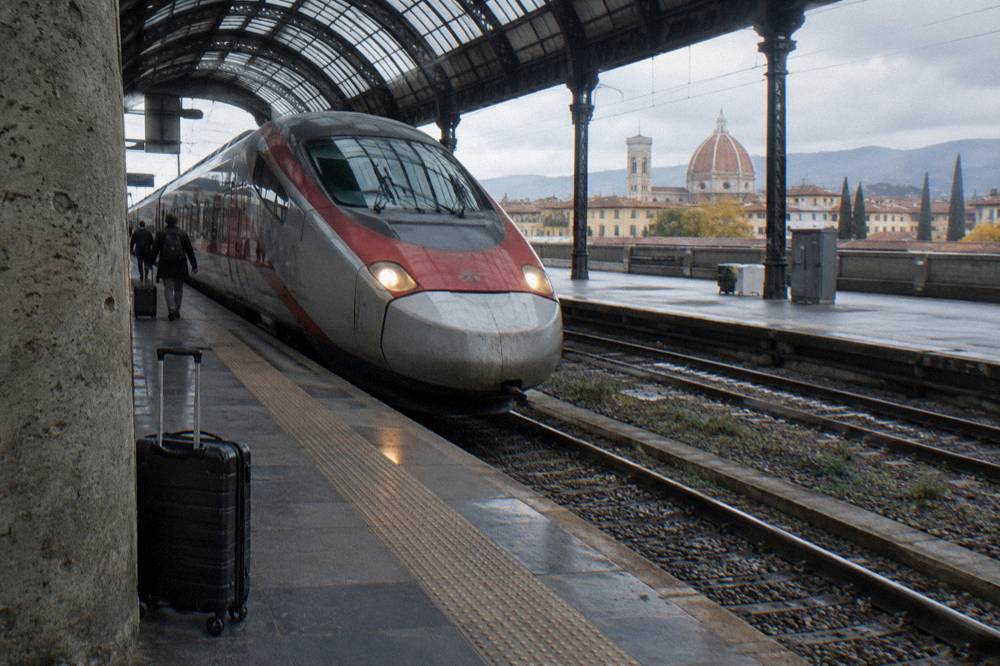
Florence and Bologna sit about 100 km apart, and the high speed connection makes them feel closer than two suburbs of Rome. The practical play is a Florence class ending by 15:00, a train shortly after, and dinner in Bologna. Doing it the other way works too: Bologna's class scene schedules around lunch, and Florence's evening slots, such as the 17:00 sessions some operators run, catch arrivals.
| Leg | Rail time | Class pairing that works |
|---|---|---|
| Florence to Bologna | ~35 to 40 minutes | Florence morning class, Bologna evening arrival |
| Rome to Florence | ~1.5 hours | Rome morning sights, Florence 17:00 class slot |
| Bologna to Rome | via Florence, ~2 to 2.5 hours total | Bologna lunch class, Rome next morning |
Rome plus Florence is the more common pairing because most itineraries already include both. The 1.5 hour train means a class in Florence does not require overnighting in Florence, though most people do. If the pasta class is the anchor of your trip rather than an add-on, base yourself in Florence: the 10:00, 13:30 and 17:00 slot pattern that operators such as the 360 panoramic pasta class publish gives you three daily chances, and the same operator notes tipping of EUR 10 to 15 per person is optional, a useful data point when budgeting the full evening.
Which City Should You Actually Book?
Book Florence for your first pasta class: it has the lowest prices, the biggest review pools to judge by, and the most daily slots. Book Bologna if you already cook and want technique rather than dinner. Book Rome only if your trip is already based there, because the class format is nearly identical to Florence's while the entry price is roughly 30 percent higher.
For most travellers the Florence decision comes down to which class, not whether Florence. The Ponte Vecchio view course, from $37 per person and rated 5.0 across 874 reviews, is the value pick; the pasta and tiramisu class with unlimited wine at 3 hours from $40 is the format pick. Florence's supply is genuinely different in scale from its rivals, and Pasta Making Course Florence tracks the whole tour list rather than one operator, which is the easiest way to see the spread before committing.
The one traveller Bologna beats Florence for is the returning student. If you have already done a wine forward group class and want to learn to roll tagliatelle properly, Bologna's EUR 65 to 155 range reflects smaller groups and longer dough work. Rome, meanwhile, rarely wins on the merits: it wins because your hotel is there, and that is a legitimate reason, just not a comparison one.
A note on timing your booking window. Search demand for Florence cooking classes peaks between March and May, at roughly 3,600 US searches a month for "florence cooking class", and bottoms out in December at about 1,600. Small kitchens with 12 seat maximums and three slots a day fill on that curve, so a spring class booked the week before is a gamble in a way a November one is not.
Common Questions About Pasta Making Classes In Italy
Is Florence or Bologna better for a pasta making class?
Florence is better for a first class: it is cheaper, from $40 per person, has more daily slots and far larger review pools to judge by. Bologna is better if you want technique, with group classes at EUR 65 to 155 focused on hand rolled egg pasta rather than a group dinner.
Is a pasta making class in Italy worth the money?
At Florence's entry price of $35 to $40 per person for 2 to 3 hours including wine and the meal you cook, most travellers judge it good value against the cost of a restaurant dinner. The calculus weakens at premium prices above $100, where you are paying for small groups and named chefs.
How much does a pasta class cost in Italy?
Group pasta classes run from $40 per person in Florence, from about EUR 52 in Rome for a three-in-one class, and EUR 65 to 155 in Bologna. Private classes cost multiples of that: one Florence operator lists private sessions from EUR 900 per group of up to six.
Can you do a cooking class in two Italian cities on one trip?
Yes. Florence and Bologna are about 35 to 40 minutes apart by high speed train, and Rome to Florence takes about 1.5 hours, so a morning class in one city and an evening arrival in the next is a realistic same day plan.
How long does a pasta making class last?
Most group classes run 2 to 3.5 hours. Florence's shortest wine forward classes are 2 to 2.5 hours, the pasta and tiramisu formats run 3 hours, and Bologna's technical sessions sit at the longer end of that range.