Best Time Of Year And Day For A Florence Cooking Class
Updated November 3, 2026
US demand for Florence cooking classes peaks between March and May and bottoms out in December, which makes spring the busiest season and winter the quietest window for the same class at the same price.
 By Andrea Bianchi, Florence pasta-making instructor
Short answer
The quietest value window is November to February, when US search demand drops to roughly 1,600 monthly searches against a March to May peak of about 3,600. For time of day, the 10:00 morning slot gives you the rest of the day free, while the 17:00 evening slot turns dinner into the class itself.
US travellers search hardest for Florence cooking classes between March and May, when the phrase "florence cooking class" peaks at roughly 3,600 monthly US searches, and lose interest in December, when it falls to about 1,600. That swing matters because class supply in the city barely changes: the same kitchens run the same 2 to 3.5 hour sessions year-round, so the calendar you pick changes crowd levels and slot availability far more than it changes price. On this page the month-by-month picture, the morning-versus-evening question, and how far ahead each kind of class actually sells out.
When Is The Best Time Of Year For A Cooking Class In Florence?
The lowest-crowd window runs from November through February, when US search demand sits near its annual floor of roughly 1,600 monthly searches, about 55 percent below the March to May peak of 3,600. The highest-demand window is March to May, when spring travellers compete for the same seats. Classes run all year, so season changes availability, not existence.
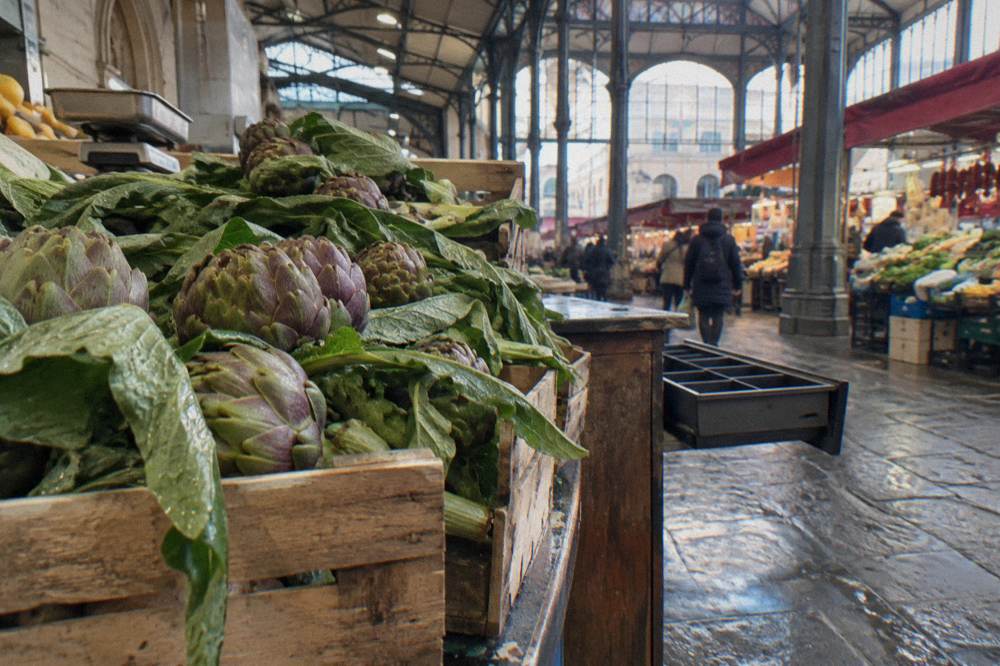
Three practical patterns follow from that swing. First, a class that sells out weeks ahead in April often has same-week seats in January, which suits travellers who build itineraries late. Second, spring visitors get a specific payoff: seasonal produce. Porcini and chestnuts run September to October, fresh-pressed olive oil (olio nuovo) lands October to November, and artichokes return in spring, so an April class may work with vegetables a November class never sees. Third, the December dip has a catch, because holiday-week classes around late December still fill with families, so the quiet month is quiet at its edges, not in its middle week.
There is also a seasonal-ingredient angle worth planning around, tracked month by month in the Tuscany month-by-month produce calendar. A class that includes a market stop is best booked when the stalls carry something worth cooking: the autumn olio nuovo window and the spring artichoke season are the two standouts.
| Window | US monthly search demand | What it means for booking |
|---|---|---|
| March to May | About 3,600 ("florence cooking class") | Peak; popular slots fill earliest |
| June to August | Between peak and low | Busy, but summer heat makes the 17:00 slot attractive |
| September to October | High; porcini and chestnut season | Autumn produce plus strong demand |
| November | Falling toward the low | Olio nuovo season, thinning crowds |
| December | About 1,600, the annual low | Quietest outside the holiday week |
If the decision is between seasons at the same budget, the pairing question comes next: many travellers combine pasta with dessert, and the pasta and tiramisu double bill guide covers how those combined classes differ from pasta-only ones.
How Does Month-By-Month Demand Change What You Pay?
Demand moves in a predictable arc: about 3,600 monthly US searches in the March to May peak, easing through summer, holding up through the September and October produce season, then dropping to roughly 1,600 by December. Prices on the whole hold steadier than demand, with group classes clustering from $35 to $58 per person across the year.
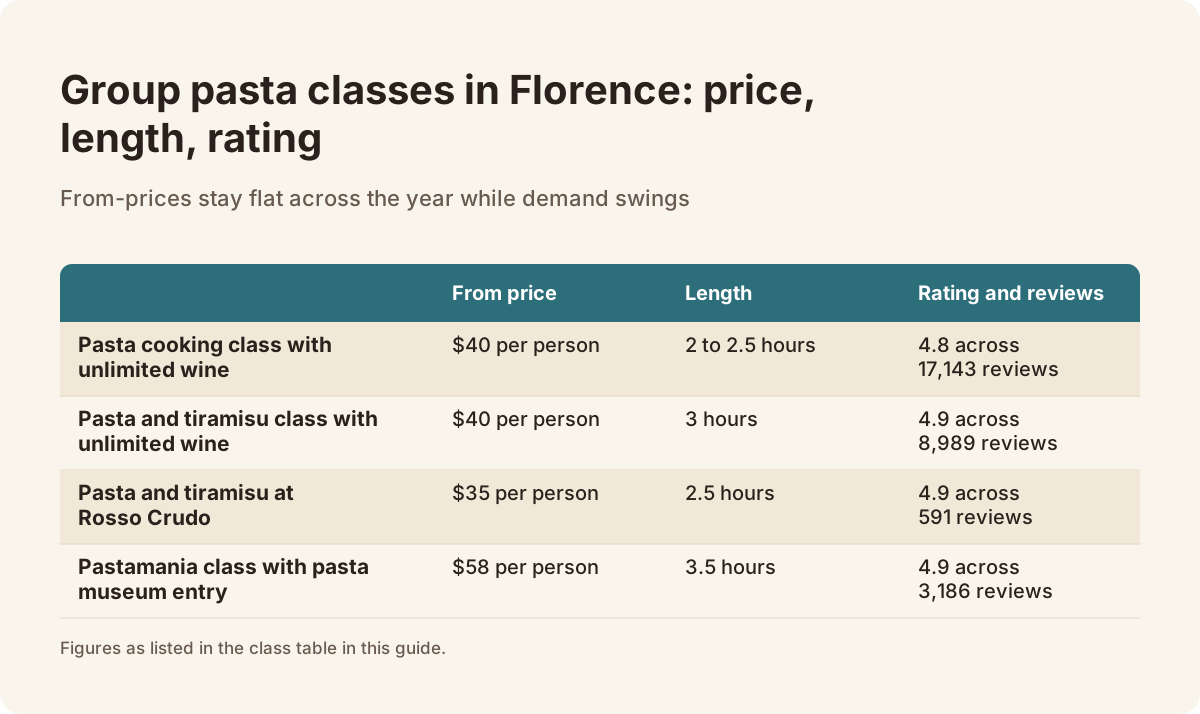
The reason prices resist the demand curve is that the big operators publish flat from-prices rather than surge pricing. The pasta cooking class with unlimited wine starts from $40 per person for 2 to 2.5 hours regardless of season; the pasta and tiramisu class with unlimited wine is also from $40 for 3 hours; Rosso Crudo's pasta and tiramisu session runs from $35 per person. What changes month to month is which slots are left, not what they cost.
A second demand layer is time of year interacting with slot time. A 13:30 afternoon session in July puts you over a hot stove at the hottest part of the day; the same session in November is the warmest place to be. Travellers asking this exact question keep it simple on Reddit too, in a long-running r/ItalyTravel thread on choosing a Florence cooking class where names like Pastamania come up again and again, mostly around booking ahead in spring.
| Class | From price | Length | Rating and reviews |
|---|---|---|---|
| Pasta cooking class with unlimited wine | $40 per person | 2 to 2.5 hours | 4.8 across 17,143 reviews |
| Pasta and tiramisu class with unlimited wine | $40 per person | 3 hours | 4.9 across 8,989 reviews |
| Pasta and tiramisu at Rosso Crudo | $35 per person | 2.5 hours | 4.9 across 591 reviews |
| Pastamania class with pasta museum entry | $58 per person | 3.5 hours | 4.9 across 3,186 reviews |
For the undecided, the best pasta making class in Florence compares these head to head, and the pasta class or pizza class comparison settles the other fork in the road.
Morning, Afternoon Or Evening: Which Slot Suits You?
A typical Florence kitchen runs three daily slots, 10:00, 13:30 and 17:00, as the 360 Cooking Class Experience schedule shows, so the real choice is what you give up: the morning slot costs you an early museum, the 17:00 slot costs you a restaurant dinner, because the class replaces it. Most pasta classes end with everyone eating what they made, often with wine poured throughout.
The morning slot is the sightseeing maximiser. You are eating your own tagliatelle by lunchtime and free for the Uffizi or a walk across Ponte Vecchio by two. The 13:30 slot turns the class into lunch itself, which pairs well with a slow museum morning. The 17:00 slot is the dinner class: three hours later you have eaten your own pasta and tiramisu and no restaurant booking is needed. In summer heat, evening is the comfortable choice; in winter, the 17:00 slot ends with a walk back through dark streets, which some travellers love and others should plan around.
Practical slot details vary by operator. The 360 kitchen on Borgo Pinti, about a 10 minute walk from the Duomo, posts its 10:00, 13:30 and 17:00 slots openly, which is worth checking against your hotel location before booking, since none of the major group classes include pickup. The Michelin-trained Pasta Class Florence runs 3 hour sessions capped at 12 people from EUR 110 on its own site, and smaller rooms like that fill on fewer dates than the big-volume kitchens.
How Far Ahead Should You Book A Florence Cooking Class?
In the March to May peak, book the popular group classes two to four weeks ahead for weekend slots and about a week ahead for weekdays; in the November to February trough, same-week booking usually works. Private classes and small rooms are the exception, and need earlier locking regardless of season.
The logic is capacity. A kitchen running three slots a day with 20 seats a slot has 420 seats a week; in April, US demand plus walk-up European travellers absorb that comfortably, and the highest-rated listings go first. A 5.0 rating across 613 reviews, like the Michelin-trained chef class from $109.50 per person, is exactly the kind of listing that fills before the broader market. In the December trough, the same kitchens chase a much smaller audience.
Two booking-time details travellers under-use. First, cancellation terms: check the operator's live listing for free-cancellation windows before paying, since terms differ by class and not by season. Second, tipping is optional and separate from the class price; operators themselves cite EUR 10 to 15 per person as a typical tip when guests want to leave one, which belongs in the trip budget, not the class price.
Should You Time A Class Around Seasonal Ingredients?
Yes, if your class includes a market visit or you care what you cook: porcini and chestnuts run September to October, olio nuovo arrives October to November, and spring brings artichokes back. A pasta shape class without a market stop changes little by season, so this only reshuffles priorities for market-and-cooking formats.
The market-based formats are the ones where timing pays. The market tour and cooking class with wine, from $77 per person and rated 4.9 across 434 reviews, shops first and cooks second, so the stalls set the menu. The stalls themselves keep fixed rhythms: Sant'Ambrogio runs Monday to Saturday roughly 07:00 to 14:00 or 15:00, closed Sunday, which is why market classes cluster in late-morning slots rather than the 17:00 session.
How Does Class Length Affect When You Should Book It?
Shorter classes, 2 to 2.5 hours, are the flexible ones you can slot into a packed day at short notice, while 3 to 3.5 hour formats, especially market and farmhouse versions, behave more like a half-day trip and deserve fixed calendar placement booked further ahead. Florence group class durations span 2 to 3.5 hours across the city's listings.
The 2 hour 30 minute fresh pasta course with a Ponte Vecchio view, from $37 and rated 5.0 across 874 reviews, is a good example of the flexible kind: a morning booking leaves the afternoon entirely yours. At the other end, the Tuscan farm class with pizza or pasta and gelato runs 5 hours from $93, transport included, with the drive to the farm taking 15 to 30 minutes each way. That one is a schedule anchor, not a filler.
Duration also decides the slot. A 3.5 hour class started at 17:00 ends near 20:30, which works as a late Italian dinner; started at 10:00 it hands you back the afternoon. Travellers keep asking how long these classes run relative to a day of sightseeing, and the honest answer is that the short pasta-only formats fit almost anywhere, while the combined, market and farm formats are the ones to place first and build the day around.
For anyone still choosing between the two big names, Pastamania versus the unlimited wine class breaks down the trade-offs, and the full comparison set sits on one tour list, including the pasta cooking class with unlimited wine, on one tour list.
Common Questions About Timing A Florence Cooking Class
When Is The Best Time Of Year For A Cooking Class In Florence?
For thin crowds, November to February, when US search demand sits near its annual low of about 1,600 monthly searches. For seasonal produce, September to November for porcini, chestnuts and olio nuovo, or spring for artichokes. Classes run year-round; only availability changes.
What Time Of Day Is Best For A Pasta Class?
The 10:00 morning slot frees the rest of your day, the 13:30 slot doubles as lunch, and the 17:00 slot replaces dinner since you eat what you made. A representative kitchen posts exactly these three slots: 10:00, 13:30 and 17:00.
How Far In Advance Should You Book?
Two to four weeks ahead for weekend slots in the March to May peak, about a week for weekdays, and often same-week in the winter trough. Small and private classes fill earlier regardless of season.
Do Cooking Class Prices Change With The Season?
Mostly no. The major group classes hold flat from-prices year-round, from $35 to $58 per person for group formats. What changes with season is which slots remain bookable.
Is A Morning Or Evening Class Better In Summer?
Evening. A 17:00 slot puts the hottest part of the day behind you, and the class ends as dinner. In winter the logic reverses and the warm midday kitchen becomes the comfortable choice.